
 Jemma Anderson
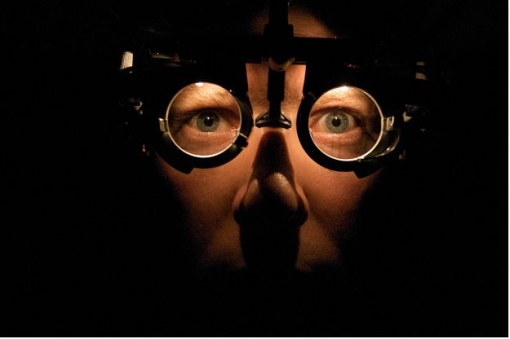
“We are literally made from scattered stardust. What started off as a big ball of hydrogen has ended up as you”.
When you think about things that way, it can be scary, huh? The above quote is taken from Sound&Fury’s Going Dark, which thoroughly investigates our abilities to understanding the universe and vision. Set in a constructed black box theatre in a corner of the London Science Museum, this 75-minute show is sure to change your way of thinking about the world we live in.
The premise is simple: Sound&Fury theatre company specialise in work that explores sensory deprivation in order to create a new way of seeing for the audience. Their pieces involve experimenting with surround sound or no visuals, for example, and this show is no different. In collaboration with writer Hattie Naylor, the production follows Max, a narrator at the city’s planetarium who guides his audience through the great expanse of our universe. Whilst also caring for his young son, Leo, he discovers that his eyesight is failing him, and it becomes a story of a man’s struggle to understand the universe around him, as well as the different kind of vision required to see things at a great distance.
The play itself is well-written, and so choc-full of facts about the universe it makes your head spin a tad. Flitting between Max’s lectures at the museum, which include a narration of the Big Bang, just how fast the Earth is spinning around the Sun (43,000 miles an hour) and how far away Andromeda is (2.5 million light years), we also get a peek into Max’s home and his relationship with his son as they struggle to adjust to Max’s diagnosis with RP (retinitis pigmentosa), a disease that affects the retina of the eye, causing blindness.
Whilst your mind is still racing with questions about the universe, life, matter and everything in between, the story is played out using Sound&Fury’s signature staging. Pitch-black darkness fills the room, so much so that it would be hard to see your own hand in front of your face, and a surround-sound of an everyday scene, for example getting on the tube, fills your ears. The noise is so detailed that you picture everything as it happens right in front of your eyes, except you’re completely blinded by darkness. A projection box is situated in the middle of the room. Several times you find yourself completely enthralled by the incredible spans of stars covering the ceiling, and your ability to spot the most famous constellations. You can’t help but be incredibly immersed in the expanse of our universe, and its astonishing beauty.
This show is bound to enthrall anyone with a thirst for knowledge about science. I can’t help but wish all my science lessons at school were this cool. With the show explicitly commenting on the idea that we are all on a journey into blindness, standing on the edge of an abyss that reflects our tiny, miniscule, minute place in the huge universe, we too begin to reflect on our journeys and how we came to be just an infinitely small piece of scattered stardust that exists in the world.
Going Dark is playing at The Science Museum until 9 March. For more information and tickets see the Science Museum website.